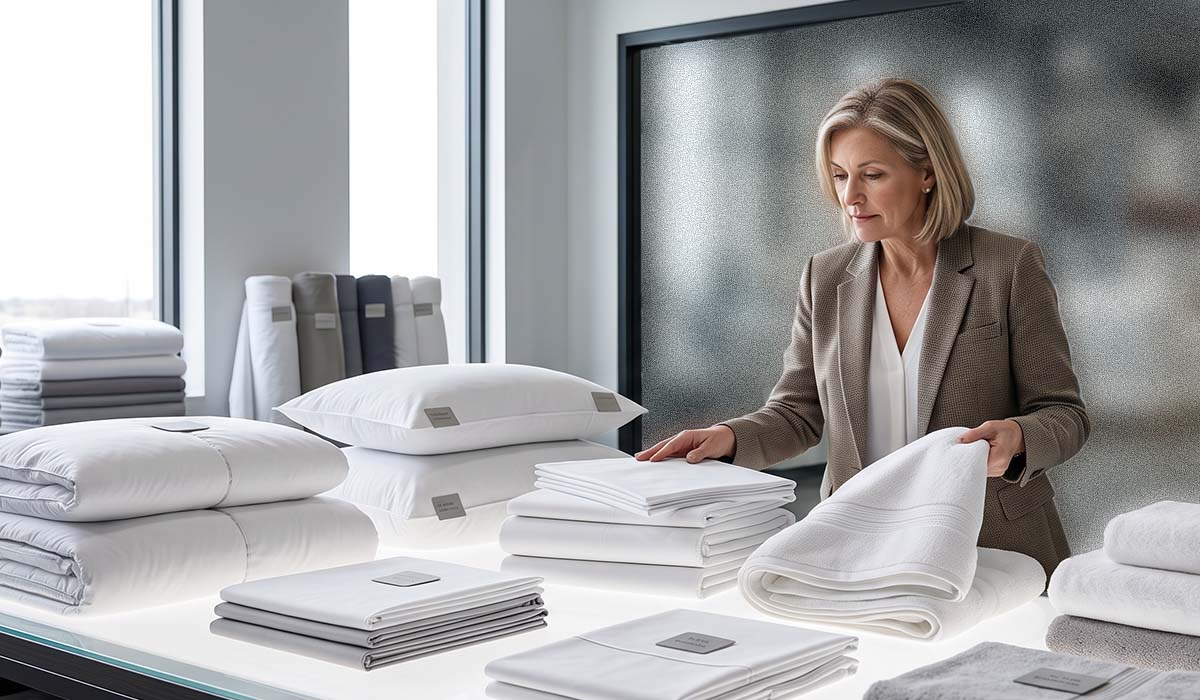
Hotel linens are one of the most important factors in the guest experience at your property. However, prioritizing softness alone often means your linens won’t survive the commercial laundry process. This situation increases your operational costs and creates constant supply chain issues. So, the key is finding the right balance between comfort and durability.
For hotel owners and procurement managers, the right buying decision therefore goes beyond softness or thread count. You need to balance guest comfort, durability, laundering performance, inventory levels, replacement costs, consistency, and supplier reliability.
This hotel linen buying guide explains what to specify, how much to buy, which materials and constructions make sense for different properties, and what to ask a wholesale supplier before placing a bulk order.
What is Included in Hotel Linen?
Hotel linen refers to the textile products used throughout guest rooms, bathrooms, and other hospitality areas.
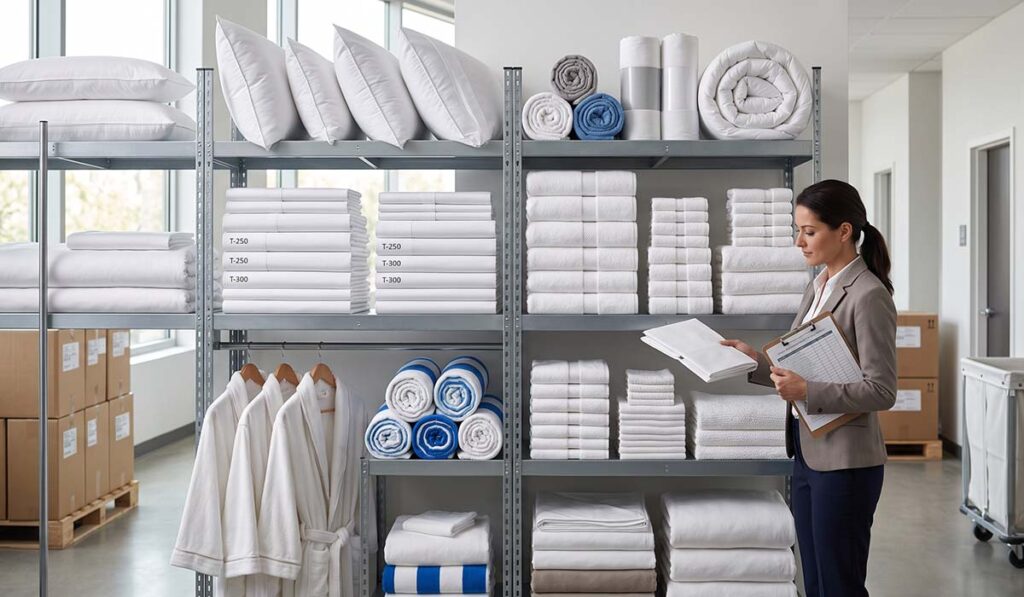
A commercial linen program may include:
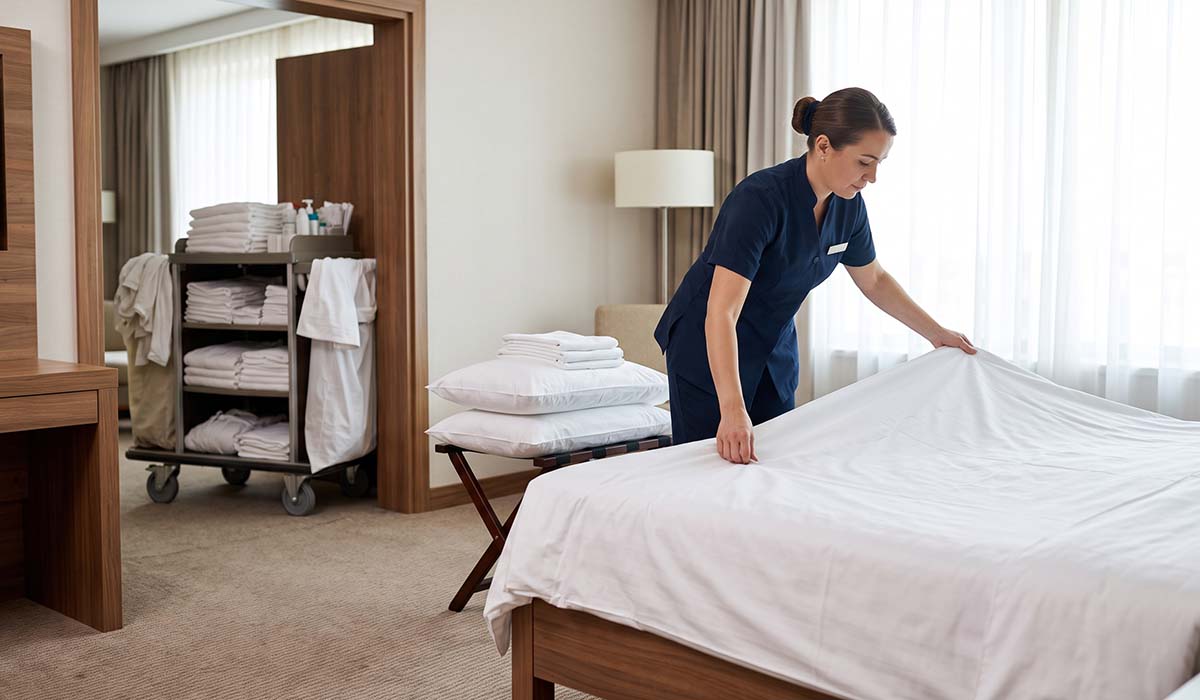
- Flat and fitted sheets
- Duvet covers and inserts
- Top sheets
- Bed skirts
- Bed scarves
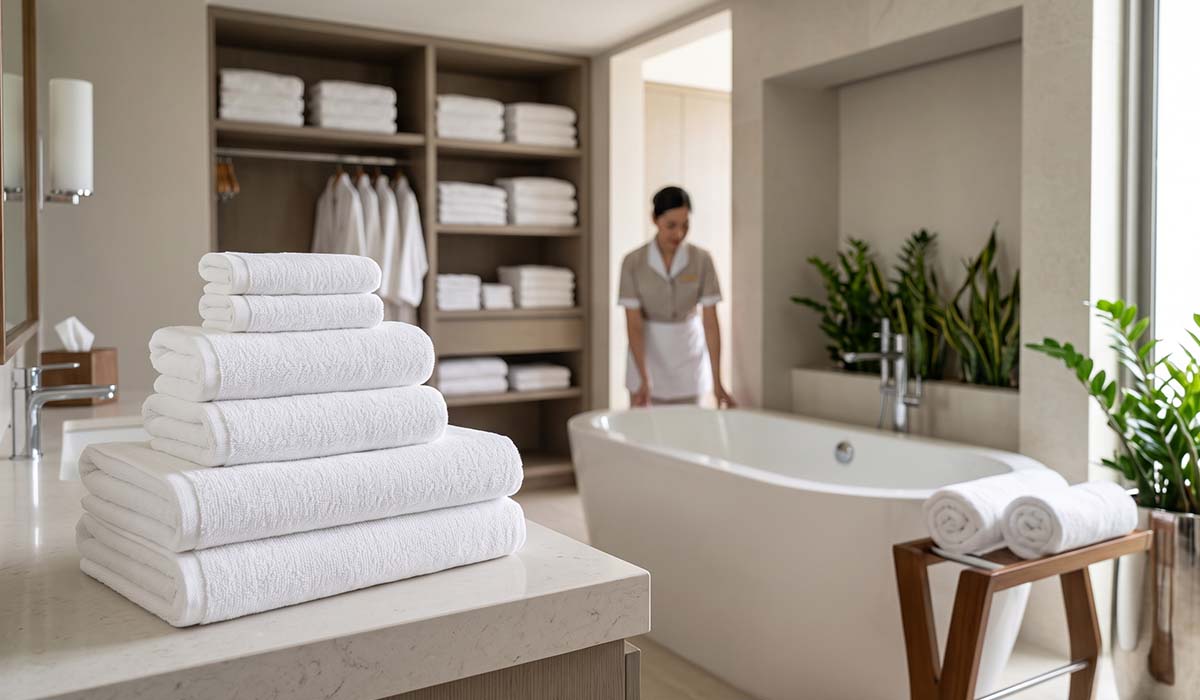
- Bath towels
- Hand towels
- Bath mats
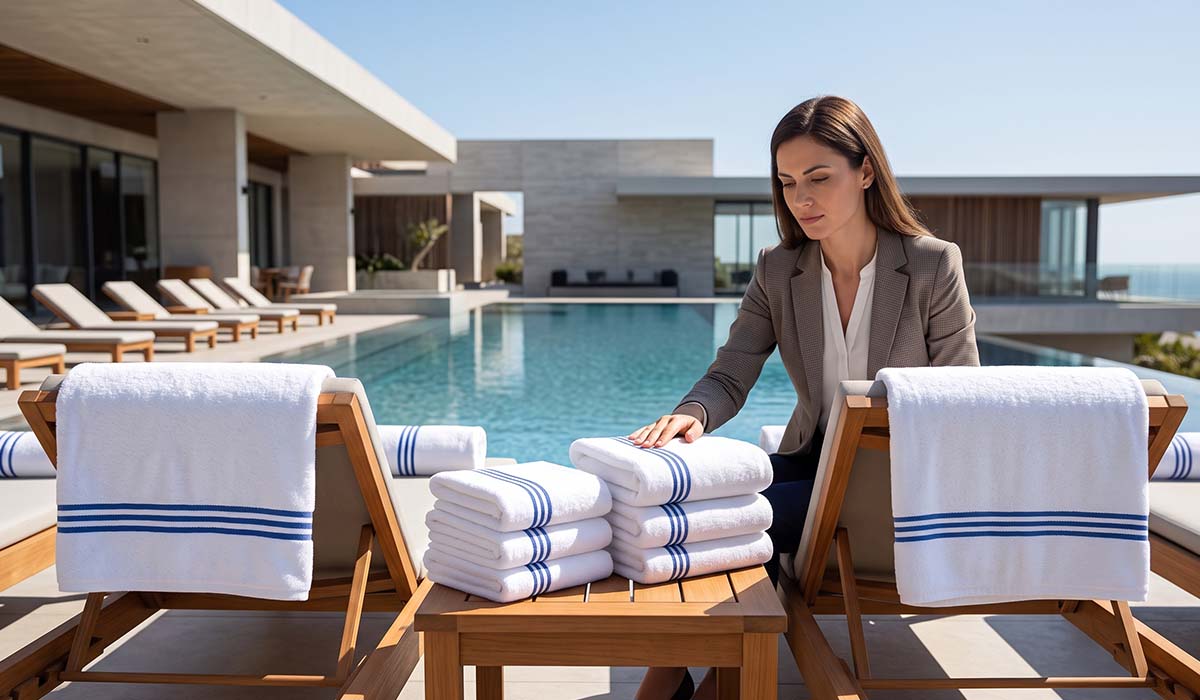
- Beach & Pool towels
- Pillows
- Pillow protectors
- Mattress pads and encasements
- Blankets
- Decorative bedding
For a hotel, these products should be purchased as part of an operating system rather than as isolated items.
What Should Hotels Consider Before Buying Linen?
The most important factors are:
- Property positioning such as budget, midscale, upscale, luxury, resort, boutique, etc.
- Weave and construction
- Thread count for bed linen
- GSM for towels
- Durability under commercial laundering
- Dimensional stability and shrinkage
- Color and size consistency
- Par-level inventory requirements
- Supplier MOQ, lead time, quality control, and replenishment capability
The mistake is simply choosing the best specification available, such as high GSM or Thread count. The better approach is to choose the specification that performs reliably in your hotel’s operating environment.
Hotel Bed Sheets: What Should You Buy?
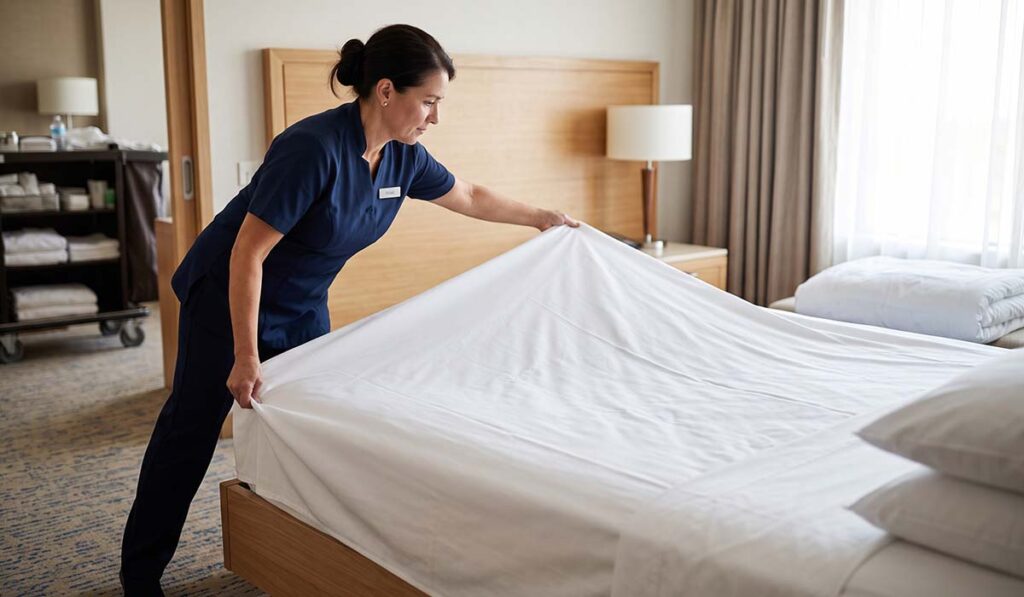
Bed sheets usually represent one of the most important parts of the guest-room linen package.
When comparing commercial sheets, evaluate fiber, construction, weave, thread count, finishing, sizing, and laundering performance together.
Cotton vs. Polycotton vs. Microfiber
| Material | Main Advantages | Best Fit |
| 100% Cotton | Breathable, natural feel, premium comfort | Luxury hotels, resorts, boutique properties |
| Polycotton | Durable, faster drying, easier maintenance | High-turnover hotels and volume operations |
| Microfiber | Fast drying, wrinkle resistance, economical | Budget and high-turnover properties |
| Cotton-rich blends | Balance of comfort and durability | Midscale to upscale properties |
Learn More: Cotton Vs. Polycotton Hotel Sheets: Which Lasts Longer?
There is no single “best” fabric for every hotel.
A luxury resort may prioritize the hand feel and breathability of cotton. A high-occupancy property with heavy laundry demands may place greater value on fast drying, durability, and operational efficiency.
ACME Textiles currently offers commercial bed sheets across 100% cotton, microfiber, and blended/polycotton categories, including T-180, T-200, T-250, and T-300 options.
Explore ACME Textiles hotel bed sheets
What Is the Best Thread Count for Hotel Bed Sheets?
For many commercial hotels, approximately 180–300 thread count is a practical range, but thread count should never be the only purchasing criterion.
Thread count measures the number of threads running horizontally and vertically within a square inch of fabric. However, a higher number does not automatically mean better hotel linen.
Fiber quality, yarn construction, weave, finishing, and manufacturing quality also affect how a sheet feels and performs.
For example:
- 180 – 200 TC: practical for economical, durable hotel programs
- 250 – 300 TC: a strong middle ground for many midscale and upscale properties
- 300 – 400 TC: suitable when a more premium hand feel is important
- Very high thread counts: should be evaluated carefully rather than purchased simply because the number is larger
Percale vs. Sateen
- Percale uses a plain weave and is generally associated with a crisp, cool hand feel.
- Sateen uses a different weave structure that produces a smoother, silkier surface and more pronounced sheen.
For hotels:
- Choose percale when crispness and breathability are priorities.
- Consider sateen when a smoother, more luxurious appearance is desired.
The right choice ultimately depends on your property’s positioning and guest expectations.
Hotel Towels: How Should You Specify Them?
Towels need a different buying framework from sheets.
GSM, grams per square meter, is one of the most useful specifications for comparing towel weight, but GSM alone does not determine towel quality.
Also evaluate:
- Fiber composition
- Yarn type
- Loop construction
- Absorbency
- Size
- Stitching
- Border construction
- Drying characteristics
- Colorfastness
- Commercial-laundry performance
What GSM Towel Is Best for Hotels?
A practical hotel towel program may span roughly 300 –700 GSM, depending on the towel type and property’s positioning.
| Towel Weight | Typical Application |
| 300–400 GSM | Lightweight, quick-drying, high-turnover operations |
| 400–500 GSM | General hotel use |
| 500–600 GSM | Upscale guest rooms and premium properties |
| 600–700 GSM | Luxury, resort, spa, and premium applications |
These are buying guidelines rather than universal hotel standards.
A heavier towel can feel more luxurious, but it also carries more water into the laundry process and may take longer to dry. In a property processing thousands of towels, that operational difference matters.
ACME Textiles offers commercial towels from 300 to 700 GSM, including 100% cotton and cotton-blend constructions designed for different operating requirements. Its range includes bath, pool, gym, spa, kitchen, and other commercial towels.
Explore ACME Textiles wholesale hotel towels
100% Cotton vs. Cotton-Blend Towels
100% cotton towels are often selected when softness, absorbency, and a premium guest experience are the priority.
Cotton-blend towels can make sense when a hotel prioritizes durability, faster drying, and laundry efficiency.
ACME’s cotton-blend towels use cotton loops with a polycotton base and are positioned for operations where faster drying and durability are important.
The correct decision should be based on cost per use, not simply purchase price.
Hotel Linen Par Levels: How Much Linen Should You Buy?
One of the most important procurement calculations is PAR inventory.
PAR represents the amount of linen needed to keep rooms operating while some items are in guest rooms, some are being processed by laundry, and some are clean and stored.
A common starting point is:
- 2 PAR: tight inventory with little operational flexibility
- 3 PAR: common starting point for many hotel operations
- 4 PAR or more: potentially appropriate when laundry turnaround is slower, linen is transported off-site, or the property needs additional operational protection
There is no universal PAR level. Your requirement depends on occupancy, housekeeping practices, laundry turnaround, storage capacity, delivery schedules, and the consequences of running short.
For example, if a hotel has 100 beds and plans around 3 PAR for a particular sheet, it would need approximately 300 units of that sheet before considering additional contingency stock.
The same logic does not apply equally to every product. Items such as pillows, mattress protectors, and duvet inserts are not normally replaced every guest stay, so they require a different inventory calculation.
The goal is not to maximize inventory. It is to maintain enough stock to avoid shortages without tying unnecessary capital up in linen.
Complete Linen Program Bedding Accessories
A complete hotel linen program goes beyond sheets.
Mattress pads, mattress encasements, pillow protectors, pillows, blankets, duvet inserts, and duvet covers all influence room performance.
Explore ACME Textiles bedding accessories
Why Mattress and Pillow Protection Matters
Protective layers can help shield higher-value bedding components from stains, spills, and routine wear.
For example:
- Pillow protectors help protect pillows from direct exposure.
- Mattress pads add a protective and comfort layer.
- Mattress encasements provide more comprehensive mattress coverage.
- Duvet covers allow the outer layer to be removed and laundered separately from the insert.
ACME’s commercial bedding accessories include pillows, pillow protectors, blankets, mattress pads, mattress encasements, duvet inserts, and duvet covers.
For procurement teams, this matters because protecting an expensive underlying asset can be more economical than replacing it prematurely.
Learn More: What Makes A Good-Quality Hotel Pillow? A Buyer’s Guide
Decorative Bedding For Hotels
Decorative bedding includes bed scarves, top sheets, bed skirts, and box spring wraps.
These products influence the visual presentation of the room and should therefore be specified for both appearance and operational practicality.
Explore ACME Textiles decorative bedding
For example, ACME offers decorative top sheets, bed scarves, bed skirts, and fitted box spring wraps designed for commercial hospitality applications.
When buying decorative bedding, evaluate:
- Color consistency
- Fabric appearance
- Wrinkle behavior
- Dimensional stability
- Laundering requirements
- Replacement availability
- Compatibility with the hotel’s room design
For properties using layered bedding systems, lightweight decorative top sheets can also be easier for housekeeping to handle than heavier bedspreads.
Commercial Laundry Should Influence Your Buying Decision
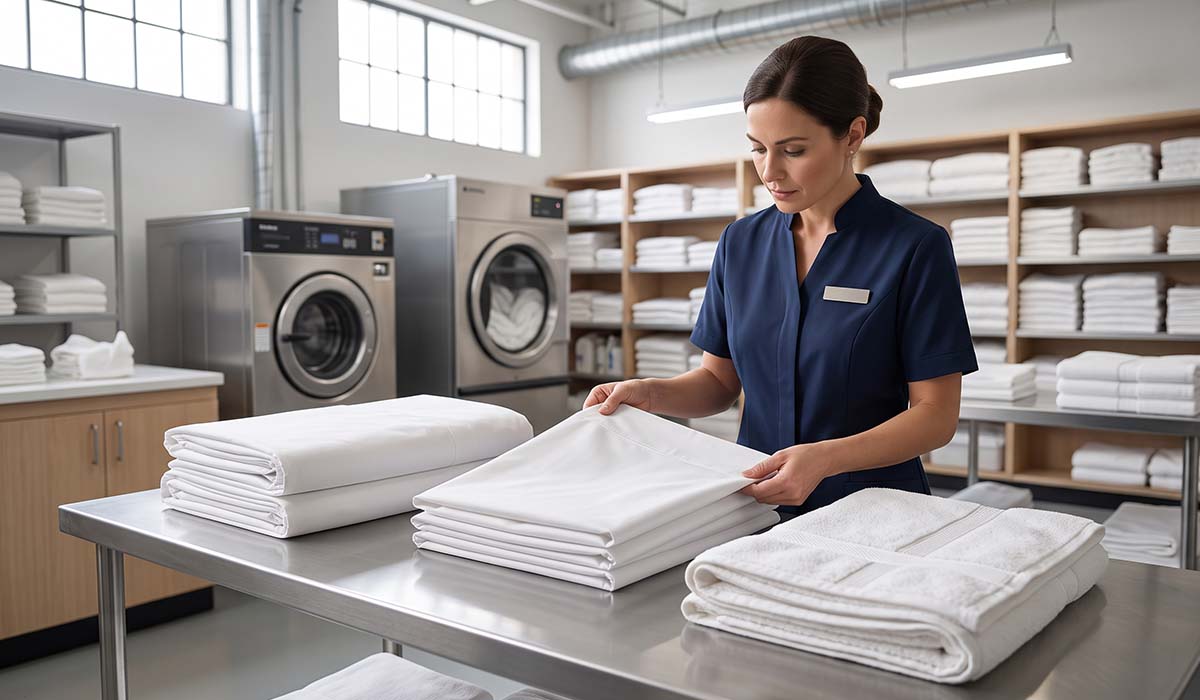
Hotel linen is fundamentally different from household linen because it may enter a commercial laundry environment repeatedly.
Before approving a product, ask:
- Can it tolerate the property’s washing process?
- How does it behave after repeated laundering?
- Does it shrink?
- Does it retain its shape?
- Does the color remain consistent?
- How quickly does it dry?
- Are seams and borders reinforced?
- Can replacement stock be matched later?
Laundry efficiency also affects operating costs.
ENERGY STAR notes that hotels and motels have substantial opportunities to reduce energy use through operational and equipment improvements, while its hospitality resources specifically address laundry and other hotel operations.
That is why fast-drying textiles can have value beyond the purchase price.
Calculate Cost per Use, Not Just Cost per Piece
A $10 sheet that needs frequent replacement may cost more over its operating life than a $13 sheet that performs reliably for longer.
A useful procurement framework is:
Cost per use = purchase cost + relevant operating costs ÷ useful service life
You do not need perfect historical data to start.
Track:
- Purchase price
- Number of wash cycles
- Replacement frequency
- Laundry problems
- Damage rate
- Labor implications
- Freight
- Storage
- Emergency replacement purchases
This gives procurement teams a better picture of total cost of ownership than unit price alone.
Learn More: How Commercial Laundering Affects The Lifespan of Hospitality Linens
Choosing the Right Hotel Linen Supplier
The supplier is just as critical as the product specification. Before committing to a bulk order, vet potential partners with these seven punchy criteria:
- Samples: Never buy sight-unseen. Inspect physical samples for hand feel, stitching quality, and true color.
- Specifications: Demand documented fiber content, thread count/GSM, and weave details. Avoid vague “luxury” labels.
- MOQ: Ensure minimum order quantities align with your property size and budget constraints.
- Consistency: Confirm the supplier can match color, size, and quality across repeat orders to avoid mismatched inventory.
- Lead Time: Vet timelines for both initial rollout and ongoing replenishment to prevent operational shortages.
- Location: Prioritize suppliers with domestic distribution (like ACME Textiles) to slash shipping times and costs.
- Customization: Check for embroidery or custom labeling capabilities to reinforce your property’s branding.
What Certifications Should Hotels Look For?
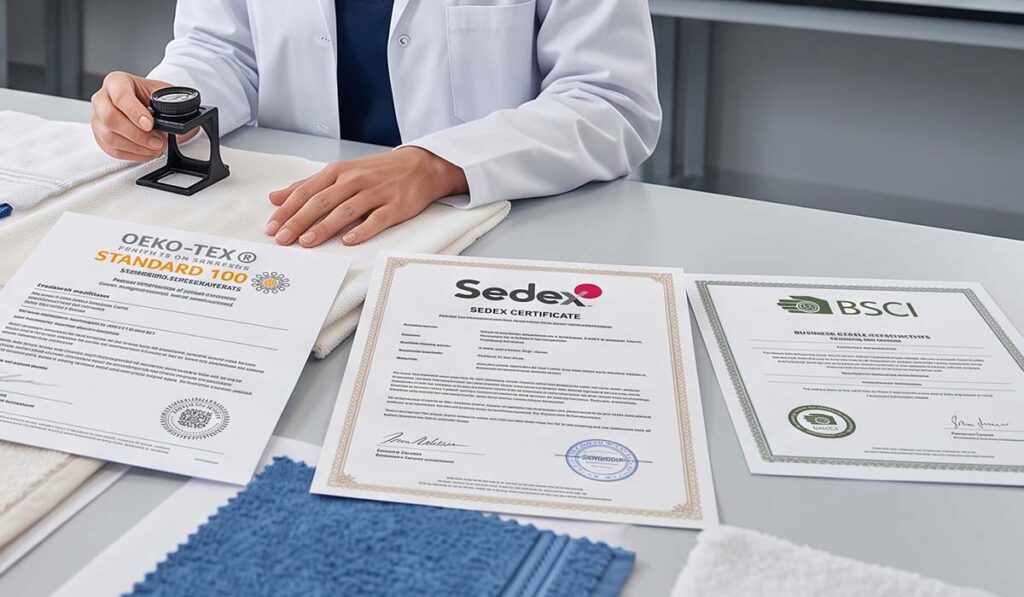
Certifications provide independent verification of critical manufacturing standards and should be evaluated based on their specific scope. Key certifications for the hospitality industry include:
- OEKO-TEX® Standard 100: Focuses on textile safety by testing for harmful substances.
- BSCI (Business Social Compliance Initiative): Evaluates social compliance, labor conditions, and workplace safety.
- SEDEX (Supplier Ethical Data Exchange): Promotes transparency, responsible sourcing, and ethical business practices.
To ensure claims are genuine rather than just marketing, buyers should request supporting documentation, such as the certificate name, number, and validity.
A claim without supporting documentation should not automatically be treated as a certification.
Learn More: Textile Certifications Every Wholesaler Buyer Should Know
Common Hotel Linen Buying Mistakes
- Focusing solely on thread count: Higher thread count doesn’t guarantee commercial performance.
- Choosing the heaviest towels: Heavier isn’t always better for laundry efficiency.
- Ignoring replacement availability: Ensure items can be consistently replenished.
- Mixing specifications: Inconsistent inventory complicates housekeeping.
- Prioritizing only unit price: Always consider the total cost of ownership.
- Neglecting PAR levels: Accurate inventory management prevents costly stockouts.
- Treating suppliers as transactional: Look for long-term consistency and reliability.
Final Takeaway: Buy Linen as an Operating System
The best linen isn’t the most expensive or heaviest; it’s the right balance of guest comfort, durability, laundering performance, appearance, inventory efficiency, and total cost of ownership.
Start by defining your property’s specific needs, from fabric construction to PAR levels, before selecting a supplier who can deliver consistency, not just the lowest price.
ACME Textiles supports U.S. hospitality teams with a full range of commercial towels, sheets, bedding, and decorative linens designed for your operational success.
Need help specifying linen for your hotel, resort, or wholesale operation?
Contact ACME Textiles for product samples, bulk pricing, and assistance selecting commercial linens that fit your property’s comfort, durability, and laundry requirements.
Explore ACME Textiles’ wholesale hotel linen collection
Frequently Asked Questions
- What is the best thread count for hotel sheets?
For many commercial applications, 200–400 TC is a practical range, but fiber quality, weave, construction, finishing, and laundering performance should also be evaluated.
- What GSM is best for hotel towels?
A practical hotel towel program can range from approximately 350–750 GSM depending on the property, towel type, guest experience, and laundry operation. Heavier does not automatically mean better.
- How many sets of linen should a hotel have?
Many hotel operations begin planning around 3 PAR, while properties with slower or outsourced laundry may require more. The appropriate PAR depends on laundry turnaround, occupancy, storage, and operating procedures.
- Is cotton or polycotton better for hotel sheets?
Neither is universally better. Cotton is often selected for premium comfort and breathability, while polycotton can provide durability, easier maintenance, and faster drying.
- What should I look for in a wholesale hotel linen supplier?
Look for consistent specifications, commercial-laundry suitability, samples, reasonable MOQ, reliable lead times, replenishment capability, quality control, customization options, and transparent product documentation.
- How can hotels reduce linen replacement costs?
Start by buying commercially appropriate products, protecting pillows and mattresses, maintaining correct laundry procedures, tracking replacement rates, and evaluating linen based on cost per use rather than purchase price alone.