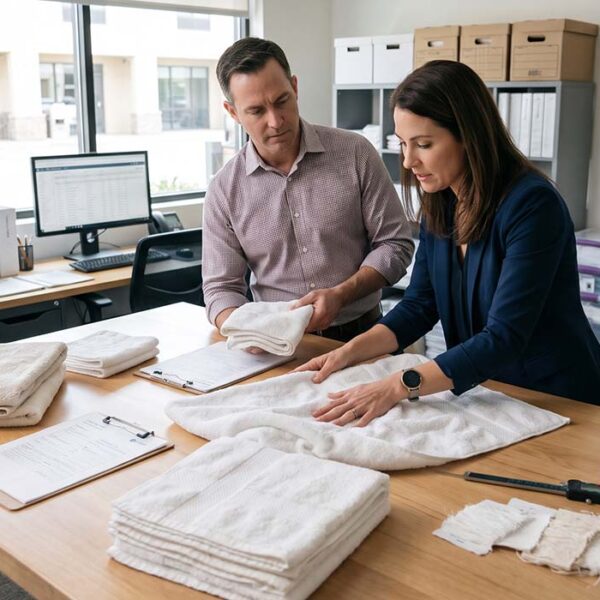
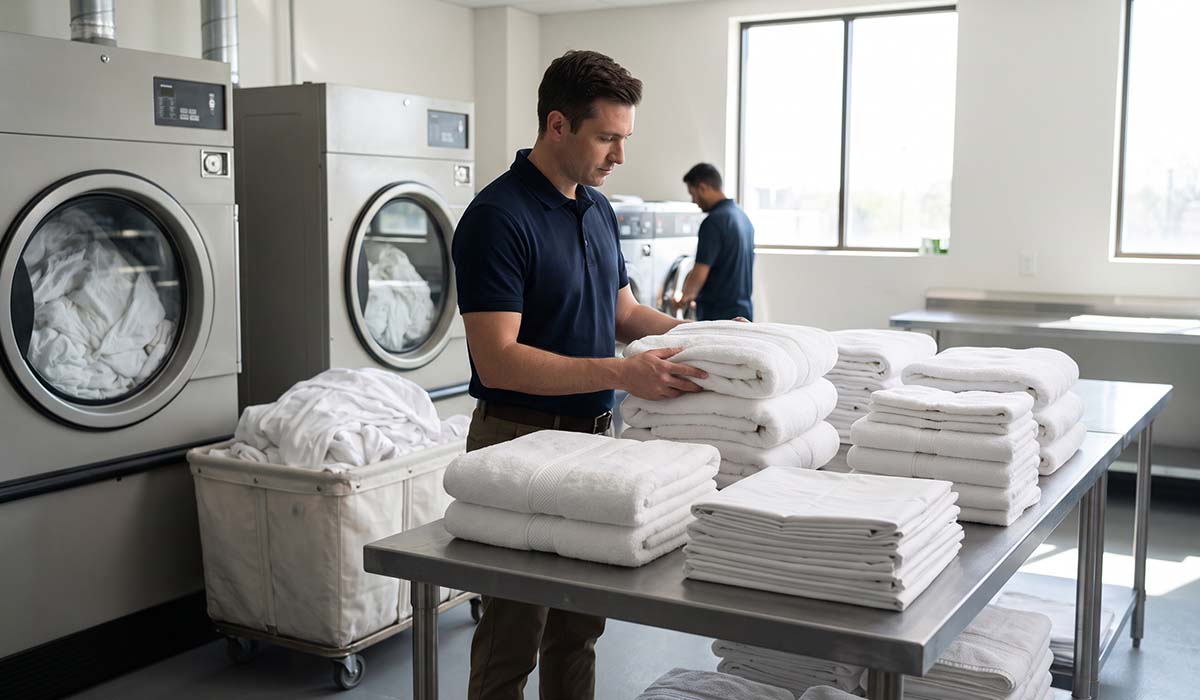
Laundry is one of the few hotel expenses that repeats every day. Every sheet, pillowcase, and towel you buy gets washed, dried, folded, and stored hundreds of times. The fabric you choose affects what you pay for labor, energy, water, and replacements, rather than just what you pay at purchase.
This guide explains how the choice of hotel linen significantly lowers hotel laundry costs, where polycotton and microfiber help, and how to compare suppliers on total cost of ownership instead of unit price.
How Can Hotels Reduce Hotel Linen Laundry Costs?
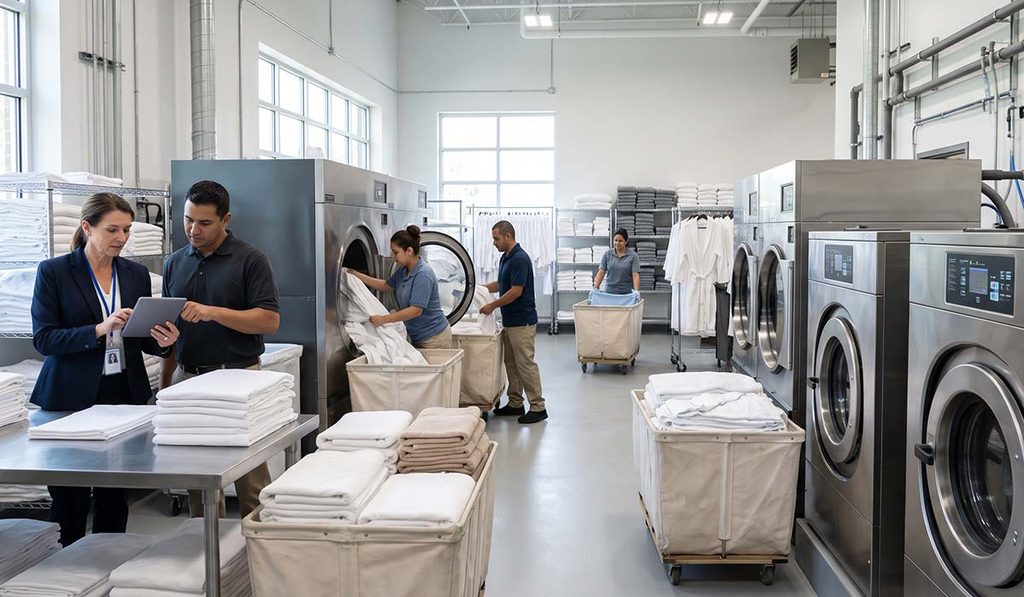
Hotels can reduce laundry costs by choosing linens that dry faster, hold less water, resist shrinkage, and survive more wash cycles. Equipment upgrades and process changes help too. But fabric is often overlooked, and it affects every wash load significantly.
The three main levers are:
- Shorter drying cycles. Less drying time means lower energy use and faster turnaround.
- Lower water retention. Linens that leave the washer-extractor drier need less dryer time.
- Longer linen lifecycle. More washes per item means fewer replacement purchases.
Where Hotel Laundry Costs Come From
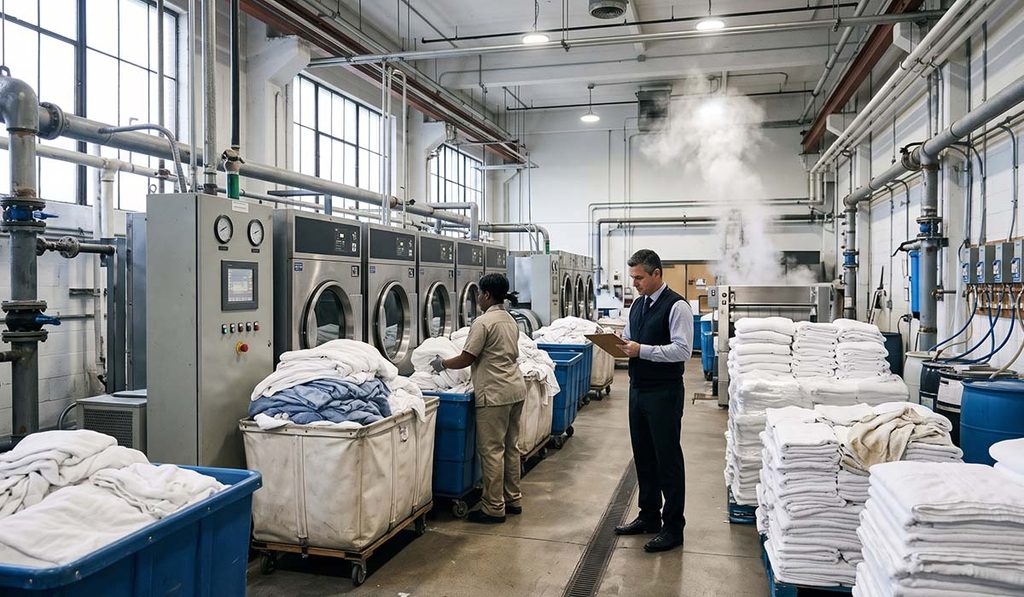
Laundry spend is more than detergent and utilities. In most operations, it includes:
- Labor: sorting, loading, folding, and handling. Faster-drying linens can also reduce how long staff wait between loads.
- Energy: drying is typically the most energy-intensive step in a laundry operation.
- Water and chemicals: driven by load size, wash cycles, and soil levels.
- Equipment wear: longer cycles mean more run-time on machines.
- Linen replacement: items retired from wear, staining, shrinkage, or pilling.
The highest cost depends on your setup. In-house laundries often feel energy and labor most. Properties using an outside laundry service feel per-pound pricing and replacement rates. Review your own numbers before deciding where to focus.
How Fabric Choice Changes Laundry Costs
Fabric composition affects how much water a linen holds and how long it takes to dry. Cotton absorbs and holds a lot of water, which is why heavy cotton towels can take long to dry. Polyester and microfiber fibers absorb far less water, so they typically release moisture faster in the extractor and dryer.
That is the basis of the savings:
- Less retained water means a shorter drying cycle.
- A shorter cycle means lower energy use per load.
- Faster loads can improve throughput on the same equipment.
- Less heat and tumbling stress can help linens last longer.
Actual savings vary with your equipment, load sizes, and utility rates, so run a sample comparison before standardizing across the property.
Learn More: Polycotton Vs. Cotton Towels For Hotels: Ultimate Buying Guide
Fabric comparison for commercial laundering
| Factor | Cotton-heavy | Polycotton blend | Microfiber |
| Drying speed | Slower | Faster | Typically fastest |
| Water retention | Higher | Moderate | Lower |
| Wrinkle resistance | Lower | Better | Good |
| Durability under frequent washing | Varies by quality | Generally strong | Generally strong |
| Best fit | Premium, cotton-feel positioning | Everyday guest rooms | Budget, high-turnover, fast-turnaround rooms |
Higher-end positioning may call for more cotton. For standard guest rooms, polycotton and microfiber are often the practical choice.
What Type of Hotel Linens are Most Cost-Effective?
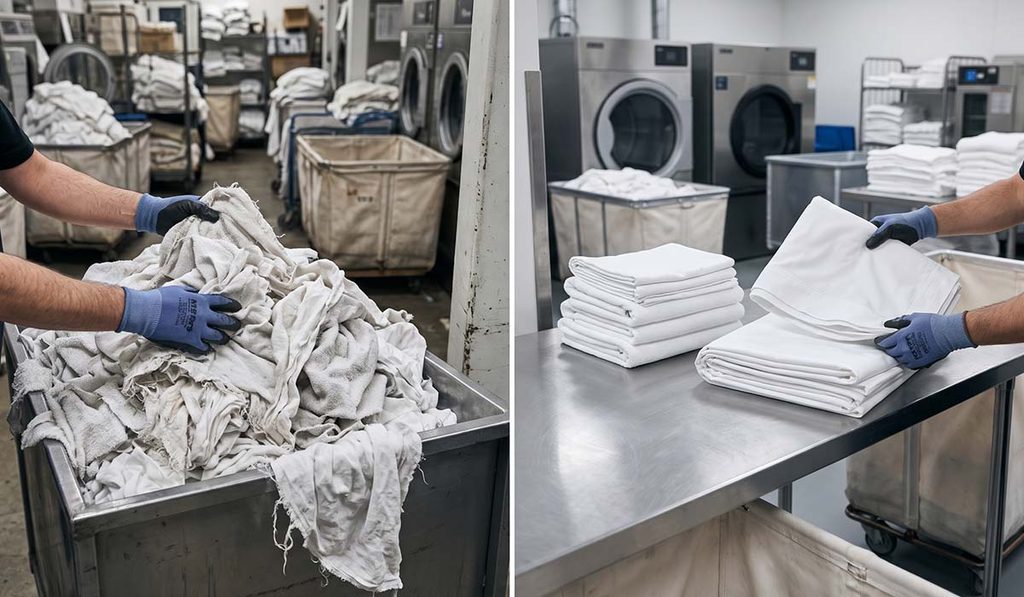
For high-volume properties, polycotton blends and microfiber are often the most cost-effective option because they combine quick drying with durability. Blended fabrics are widely used in commercial laundering because the polyester content adds strength and reduces wrinkling. Together with lower moisture retention, this can lower the cost of every wash cycle.
Total Cost of Ownership For Hotel Linen
Total cost of ownership (TCO) is the full cost of a linen over its life: purchase price, laundering, handling, and replacement. A cheap sheet that frays after a short life can cost more than a sturdier one.
A simple starting formula:
Cost per use = (purchase price ÷ expected wash cycles) + laundering cost per wash
Let’s say a sheet costing $10 that lasts 100 washes has a purchase cost of $0.10 per use. A $14 sheet lasting 200 washes costs $0.07 per use, before counting any drying-time savings. Use your own prices, wash counts, and utility rates.
Track these over a few months:
- Wash cycles before retirement
- Reasons for retirement (stains, thinning, shrinkage, seam failure)
- Drying time per load
- Par levels and replacement orders
Learn More: What Should Hotels Look For When Buying Blankets in Bulk
Hotel Linen by ACME Textiles that Support Lower Laundry Costs
ACME Textiles supplies wholesale hospitality textiles built around everyday commercial use. These categories are a logical starting point for a cost review.
Our cost-effective hotel sheets option includes Opal Super Blend everyday sheets, a polycotton option for standard rooms. Opal fast-drying microfiber sheets suit properties where quick turnaround matters most.
Match them with Opal Super Blend pillowcases or Opal microfiber pillowcases. If you want a smoother hand feel, the Icon T-200 percale sheets offer a step up. Browse all blended bed sheets and microfiber bed sheets.
In our hotel towel collection, Opal Super Blend Plus bath towels are a blend option for guest bathrooms. For pools and fitness areas, see pool towels and gym towels, which are high-volume items where drying time and replacement rates add up quickly.
Waterproof mattress encasements and pillow protectors shield the expensive items from stains and wear. Replacing a protector costs far less than replacing a mattress or pillow.
Confirm exact fabric composition, weights, sizes, and care instructions with ACME before purchase, as specifications vary by product.
How To Reduce Linen Replacement Costs in Hotels?
Hotels reduce replacement costs by matching fabric to use, controlling laundry practices, and tracking why linens are retired.
- Match product to room type. Use blends for high-turnover rooms and reserve cotton-rich lines for premium categories.
- Follow care instructions. Excess chemicals, overloading, and over-drying shorten linen life.
- Separate by type and soil level. Mixed loads add wear.
- Use protectors. Encasements and pillow protectors keep stains off bedding.
- Sort stained items early. Stain removal often adds extra cycles.
- Set par levels deliberately. A common planning approach is to hold several sets per bed to cover use, laundry, and storage, but the right number depends on your turnaround.
- Rotate stock. Even rotation spreads wear across all items.
How Often Should Hotels Replace Their Linens?
There is no single replacement interval. Replace linens when they show thinning, persistent staining, fraying seams, shrinkage that affects fit, or loss of guest-facing appearance. Frequency depends on fabric quality, wash practices, occupancy, and brand standards. Tracking wash counts and retirement reasons gives you data for your own property.
Learn More: How to Keep White Hotel Sheets Bright: Laundering Guide
Common Mistakes to Avoid While Trying To Reduce Hotel Linen Costs
- Buying on unit price alone. TCO tells the real story.
- Skipping sample trials. Test in your own machines before bulk orders.
- Mixing too many linen types. Standardization simplifies sorting and inventory.
- Ignoring laundry settings. Even good linens fail under harsh cycles.
- Not tracking retirement reasons. Without data, you can’t tell whether product or process is the problem.
ACME Textiles: Trusted Manufacturer & Hotel Linen Supplier in The US
As a leading manufacturer and hotel linen supplier, ACME Textiles specializes in high-performance bedding, bath towels, and protective covers tailored specifically to the hospitality industry. By combining durable fabrics with commercial-grade construction, our products are engineered to withstand frequent laundering while maintaining their soft feel and vibrant appearance.
Whether you operate a boutique hotel or a large-scale resort chain, ACME Textiles provides reliable inventory, consistent quality, and scalable supply solutions to help optimize your operational costs and elevate the guest experience.
Frequently Asked Questions
- What is the biggest laundry expense for hotels?
It depends on the operation. In-house laundries typically feel labor and energy most, while properties using outside services feel per-pound fees and replacement cycles.
- How do quick-dry towels save money?
They shorten drying cycles, which reduces energy use and can increase throughput on existing equipment.
- Are polycotton sheets good for hotels?
Yes, for many properties. Polycotton blends are widely used in hospitality because they resist wrinkling and hold up to frequent washing. Cotton-rich sheets may suit luxury positioning better.
- Do microfiber sheets work in commercial laundry?
Yes. Microfiber holds less water, so it often dries quickly. Follow the manufacturer’s care guidance on heat settings and avoid fabric softeners, which can reduce performance.
- What type of hotel towels last longest?
Durability depends on fiber quality, construction, and care. Blended towels are often chosen for long life under frequent washing. Ask suppliers for wash-trial data.
- How can hotels reduce linen shrinkage?
Follow care instructions, avoid excessive dryer heat, and request shrinkage specs and samples before bulk purchase.
- What should hotels look for in wholesale linens?
Fiber composition, weight, durability under commercial washing, consistency across reorders, MOQs, lead times, and supplier reliability.
- Is the cheapest linen the most cost-effective?
Not usually. A low price can mean more replacements and higher laundry cost per use. Compare the total cost of ownership.
Final Words
Lowering your hotel’s laundry budget requires evaluating the total cost of ownership rather than focusing solely on upfront product costs. By choosing fast-drying, durable fabrics like polycotton blends or microfiber, protecting your bedding investments, and tracking your laundry operations, you can significantly reduce ongoing utility, labor, and replacement expenses while maintaining standard guest satisfaction.
Visit ACME Textiles today and explore our extensive range of durable and cost-effective hotel linen.