 Germany
 UK
UK
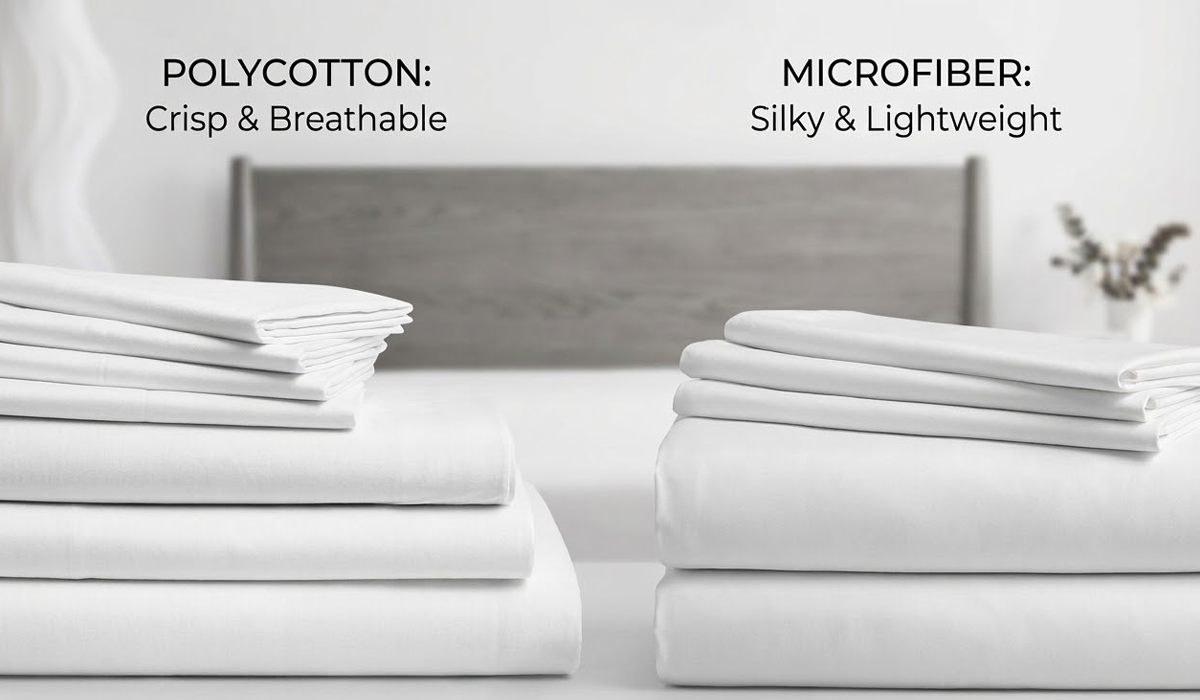
The ideal bed in the global hotel industry constantly changes. As a supplier, you’re providing more than just fabric; you’re supplying a durable product that operates nonstop under harsh hospitality use. The conflict between making guests comfortable and keeping operating costs low is the core issue when choosing between Polycotton and Microfiber.
At ACME Textiles, we have spent decades perfecting the chemistry and weave of these two hospitality sheets. For the distributor, understanding the technical nuances of these materials isn’t just about product knowledge; it’s about providing the consultative expertise that turns a one-time buyer into a lifelong partner.
Let’s dive deep into the technical, financial, and experiential differences between polycotton and microfiber linens.
1. The Anatomy of the Fiber: Natural Resilience vs. Synthetic Precision
To educate your clients, you must first explain what is happening at a microscopic level.
Polycotton: The Engineered Classic
Polycotton is an “intimate blend” of natural cotton fibers and synthetic polyester filaments. In our premium hospitality range, we typically utilize a 60/40 or 50/50 ratio.
- The Cotton Core: Provides the “wicking” action. It absorbs moisture from the sleeper’s skin and allows it to evaporate, preventing that “clammy” feeling.
- The Polyester Skeleton: Acts as a structural reinforcement. It prevents the cotton from shrinking and provides the tensile strength needed to survive industrial ironers and high-heat drying.
Microfiber: The High-Tech Disruptor
Microfiber is not just “polyester.” It is a specialized fiber measured in denier (the linear mass density of fibers). For a fabric to be classified as microfiber, it must be finer than 1 denier, approximately 1/100th the thickness of a human hair.
- The Structure: These fibers are often split during the manufacturing process to create a massive surface area. This results in a fabric that feels incredibly soft (often compared to silk or suede) but is composed entirely of rugged, non-absorbent synthetic material.
Learn More: How To Maximize Profit as a Hospitality Supply Wholesaler?
2. The Operational Efficiency Matrix: Laundry & Labor
For a hotel manager, the cost of the sheet is a fraction of the cost of cleaning the sheet. This is where you, the distributor, can prove the ROI of your inventory.
Drying Times & Energy Costs
In an industrial setting, the dryer is the most expensive machine to run.
- Microfiber: Because the fibers are synthetic and non-porous, they do not “soak” in water; they merely hold it between the threads. Microfiber linens can dry 40% to 50% faster than 100% cotton and about 20% faster than polycotton. This translates to massive savings on utility bills and faster room turnover.
- Polycotton: While it takes longer to dry than microfiber, it is still significantly more efficient than pure cotton. It offers a “middle ground” for properties that want the feel of natural fiber without the astronomical energy costs of a 100% cotton program.
Wrinkle Recovery and Presentation
- Microfiber: Often marketed as “wrinkle-free.” For mid-scale motels or vacation rentals (Airbnbs) that lack a flatwork ironer (mangle), microfiber is the gold standard. It can be pulled straight from the dryer and placed on the bed with a smooth, professional finish.
- Polycotton: It requires a light press to achieve that “crisp” 5-star look. However, the polyester content ensures that once it is on the bed, it stays taut and doesn’t develop the “lived-in” wrinkles that plague 100% cotton sheets by midnight.
3. Durability and Longevity: The 100-Wash Test
Hospitality linen is subjected to “torture testing” every single day: high-pH detergents, bleach, high-heat drying, and the mechanical stress of industrial washers.
| Durability Factor | Polycotton (T-200/T-250) | Microfiber (90-110 GSM) |
| Tensile Strength | Very High (Cotton adds grip, Poly adds pull). | Extreme (Synthetics rarely tear). |
| Shrinkage Control | 2-3% Max (Preserved by Poly skeleton). | 0% (Synthetics are heat-set). |
| Pilling Resistance | High (If “combed” yarns are used). | Moderate (Low-quality microfiber pill). |
| Color Retention | Good (Cotton can fade over time). | Superior (Color is locked in the resin). |
Distributor Note: At ACME Textiles, we use long-staple fibers in our polycotton to ensure that the “pilling” common in cheap blends is virtually eliminated. When selling to your clients, remind them that a cheaper sheet that pilled in 20 washes is actually 3x more expensive than a quality sheet that lasts 150 washes.
Learn More: Wholesale Bed Sheets: Quality Standards Distributors Must Know
4. The Guest Experience: Breathability vs. Softness
At the end of the day, a hotel’s reputation lives or dies by the “Review.”
The “Cool” Factor (Polycotton)
Polycotton is the king of thermoregulation. Because it contains natural cotton, it allows air to circulate. It is “breathable.” For guests who “sleep hot,” polycotton is a necessity. It provides that classic, crisp, cool-to-the-touch sensation that is synonymous with luxury hospitality.
The “Cozy” Factor (Microfiber)
Microfiber provides an immediate sense of “brushed” softness. It feels warm and inviting. However, because it is synthetic, it is less breathable. In colder climates or for guests who prefer a “velvety” feel, microfiber is a huge hit.
5. Strategic Selling: Which Product for Which Client?
As a wholesaler, your goal is to reduce returns and maximize re-orders. Use this mapping to guide your clients:
Case A: The High-Volume 3-4 Star Hotel
- The Choice: T-200 Percale Sheets or T-250Satin Bed Sheets
- Why: These properties need to signal “quality” to guests who expect a traditional hotel experience. Polycotton offers the crispness of luxury at a price point that allows for frequent replacement cycles.
Case B: The Budget Motel or Extended Stay
- The Choice: 100 GSM to 120 GSM Microfiber
- Why: These businesses operate on razor-thin budgets. The savings on laundry energy and the lack of need for professional ironing are the primary drivers of profitability here.
Case C: The Vacation Rental & Airbnb Market
- The Choice: Microfiber Sheets
- Why: Most Airbnb hosts wash their own laundry. Microfiber’s quick-dry and wrinkle-resistant nature allows for faster “turnovers” between guests without the need for professional linen services.
Case D: Healthcare and Institutional Facilities
- The Choice: T-180 Economy Hotel Bed Sheets
- Why: Frequent high-heat bleaching is required for sanitation. Polycotton stands up to these harsh chemicals better than almost any other fabric.
Case F: Luxury Resorts and 5-Star Hotels
- The Choice: T-300 Luxury Cotton Sheets
- Why: In ultra-luxury lodging, guest perception is prioritized over operational efficiency. The luxury standard is 100% cotton with a T300 thread count, offering superior breathability, a substantial feel, and a crisp, cool touch.
While cleaning costs are higher than for polycotton or microfiber, luxury properties use this linen as a core element of their brand promise and premium pricing.
Learn More: What Are Microfiber Sheets Made of?
ACME Textiles: Trusted Hospitality Textile Manufacturer Worldwide
When you supply your clients with ACME Textiles Bed Linen, you are providing more than just thread; you are providing a legacy of manufacturing excellence.
- Consistency: Our looms are calibrated for hospitality standards. This means the T-200 sheet you buy today will match the T-200 sheet you buy two years from now.
- Global Export Expertise: We understand the logistics of international trade, ensuring that your wholesale orders arrive on time, properly baled, and ready for distribution.
- Sustainability: We are constantly refining our processes to reduce water usage in our dyeing and finishing stages, helping you meet the “Green” requirements of modern hotel chains.
Final Words
There is no single “best” sheet, only the best sheet for the application.
- Polycotton is the best choice for distributors serving clients who prioritize guest perception, breathability, and a traditional luxury feel.
- Microfiber is the best choice for distributors serving clients who prioritize operational cost-cutting, ease of maintenance, and aggressive pricing.
By carrying both ranges from ACME Textiles, you position yourself as a total-solution provider, capable of outfitting everything from a 500-room city center hotel to a boutique seaside retreat.
Ready to Stock the Best in Hospitality?
Don’t let your clients settle for inferior linens that gray and tear after ten washes. Give them the durability of ACME Textiles. Request a sample or contact us today to get our latest digital catalog and wholesale price list. Let’s build a more comfortable and more profitable hospitality industry together.